
Fabrication
Laser Cleaning Machine
50W to 500W pulsed fiber laser cleaning. Remove rust, paint, mill scale, and oxide layers with no chemicals, no abrasive media, and no surface damage to the base material. Portable handheld option available.
Product Line
C Series
 1 / 2
1 / 2C Series
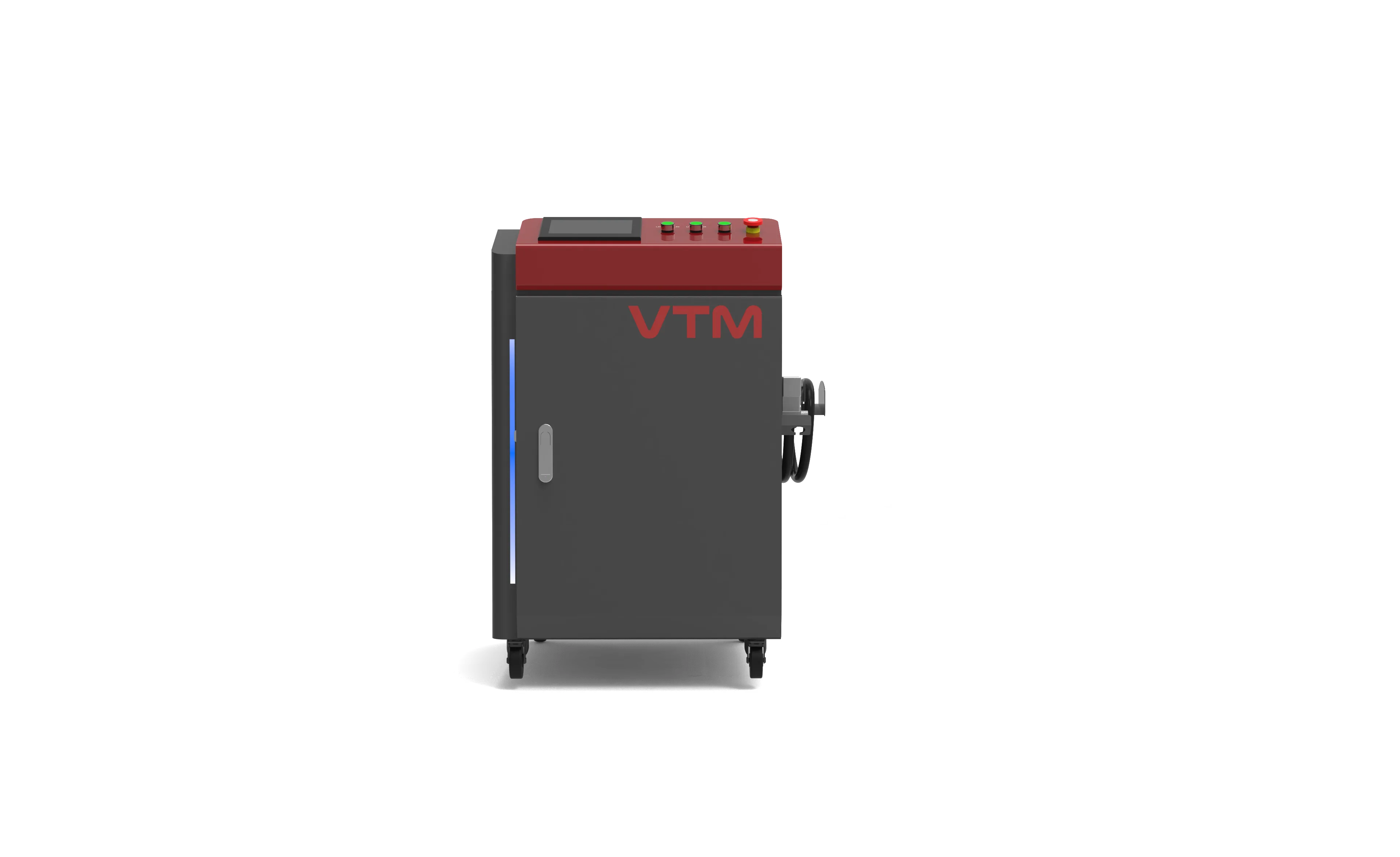
Two laser technologies — continuous for high-speed industrial cleaning, pulsed for precision surface treatment across a wide range of materials.
Request a Quote| Specification | Continuous Laser Model |
|---|---|
| Laser Power Supply | 1000 W / 1500 W / 2000 W / 3000 W |
| Advantage | High power, fast cleaning speed |
01
No Chemicals — Compliant by Design
Eliminate chemical stripping solvents, neutralizers, and disposal costs entirely. Laser cleaning vaporizes contaminants with photon energy — the only byproduct is airborne particulate, handled by a standard fume extractor. No EPA waste disposal permits required for the cleaning process itself.

02
No Media Blasting — No Embedded Abrasive
Sand and grit blasting embed abrasive particles into the metal surface — a contamination problem for precision welding and coating adhesion. Laser cleaning leaves a chemically clean surface, ideal for pre-weld prep, thermal spray adhesion, or paint primer bonding.

03
Precisely Targeted — Cleans Only the Contamination
Pulse parameters are tuned to ablate the contaminant layer while reflecting off the substrate beneath. Remove rust from a chrome-moly tube without etching the base metal. Clean weld spatter from a machined surface without changing surface finish. No masking required.
04
No Substrate Damage — Safe for Precision Components
Unlike blasting (which deforms the surface) or chemical stripping (which can cause hydrogen embrittlement), properly tuned laser cleaning leaves the substrate metallurgically unchanged. Suitable for aerospace components, high-strength fasteners, and thin-wall precision tubing.

Technology
Laser Cleaning vs. Chemical Stripping / Sandblasting
| Feature | Laser Cleaning | Chemical / Blast |
|---|---|---|
| Chemical waste | None | Significant — EPA disposal required |
| Abrasive media | None | Ongoing media cost and disposal |
| Substrate damage risk | None (correctly tuned) | Dimensional change, embedding, embrittlement |
| Precision control | Layer-by-layer selectivity | All-or-nothing |
| Pre-weld cleanliness | Oxide-free, ready to weld | May require additional cleaning |
| Portability | Handheld — goes to the part | Fixed booth or large equipment |
| Operator PPE | Laser eyewear + respirator | Full blast suit or chemical PPE |
| Initial equipment cost | Higher | Lower |
Get Pricing
Request a Quote
Tell us about your shop and the work you're doing. We'll respond with pricing, lead time, and recommended configuration within one business day.
- No obligation
- Response within 1 business day
- Speak directly with a machine specialist
Continue Exploring
Related Machines


Questions
Frequently Asked
Yes. The 200W and 500W systems remove heavy rust and mill scale in a single pass on most carbon steel sections. For extremely thick corrosion layers (>2 mm), multiple passes may be required. The pulsed laser vaporizes iron oxide while the underlying steel reflects the energy — a physical property difference that allows complete rust removal without steel loss.
Laser cleaning is considered superior to mechanical or chemical pre-weld prep for critical welds. It removes surface oxides, hydrocarbon contamination, and mill scale down to bare metal, leaving a surface that promotes full fusion and reduces porosity. Many aerospace and pressure vessel fabricators use laser cleaning specifically because it produces a reproducible, verifiably clean surface.
Yes. By adjusting pulse frequency and energy density, the laser can ablate a coating layer without marking the substrate. This is useful for removing paint from aluminum extrusions for re-anodizing, stripping powder coat for repair welding, or selectively cleaning a painted surface without masking adjacent areas.
The laser cleaning systems are FDA Class IV. Mandatory requirements include appropriate laser safety eyewear (OD 5+ at 1064 nm) for the operator and anyone in line of sight, a fume extractor running at all times, and appropriate signage. VTM provides a complete safety startup package and laser safety officer training coordination with every system.
Laser cleaning has near-zero consumable cost after purchase — electricity and periodic optic cleaning are the only ongoing costs. Sandblasting requires continuous media purchase, containment booth maintenance, and regulatory disposal of contaminated media. Most customers find laser cleaning reaches operating cost parity with sandblasting within 12–18 months, depending on volume.
Yes. The 200W and 500W systems are available with an automation integration package including mounting brackets, industrial Ethernet control, and configurable scan patterns. The laser can be triggered by PLC signals to clean specific zones as parts move through a conveyor-fed line. Contact your VTM sales engineer for integration design support.
Laser Cleaning Machine